
The best small backyard ideas for kids start with what you can see from your chair: the gate, any water, and one open play patch of about 8 by 8 feet. Fill that patch with movable things (a washable mat, a covered digging box, a shade canopy) instead of a big fixed play set, keep a 36-inch walkway to the gate, and leave one comfortable adult seat facing the action.
A small yard has to keep working after playtime. Someone still needs to carry a watering can through, open the gate with the groceries, and sit down at 7 p.m. without stepping on a toy truck.
The good news is that young children rarely need much. A patch of open ground, something to dig, something to pour and somewhere shady to flop will carry most afternoons. The work is fitting those pieces around the way your family already moves through the yard.
Recommended products for a small backyard play area


Recommended blogs
- Small backyard ideas without grass
- Small townhouse backyard ideas
- Small backyard makeover
- Small backyard seating ideas
- Small backyard ideas for dogs
12 family-friendly ideas with breathing room
Picture an ordinary Wednesday afternoon, not the tidiest five minutes of the week. Everything here gets used most days and can be seen from a chair. Most of it also packs away or does a second job for the grown-ups.
Most of them fit a yard of 300 to 600 square feet with room left over for a chair and some planting. Measure every piece in use, with lids open and chairs pulled out, not just its size on the box.
1. Shared table for everyone
One sturdy outdoor table can host drawing at one end and coffee at the other. A 30 by 48 inch table seats four and works for meals too, so it’s in use every day, not just at playtime.
Leave about 36 inches behind each chair so people can pull out and stand without bumping the fence. A small lidded tub of crayons and paper under the table keeps art supplies from drifting across the patio.
2. Moveable play patch
Keep the middle simple: one washable mat around 6 by 8 feet, a basket of today’s toys and open ground around it. In the morning it holds blocks in the shade; after lunch it rolls up and the same spot hosts a ball game.
This suits narrow and odd-shaped yards best, because the play area can vanish when adults need the space. The catch is the reset: plan on 5 minutes at the end of the day to shake out the mat and put it away so the grass underneath doesn’t yellow.
3. Chalk surface by seating
A dark chalk panel on a plain fence brings color without adding any equipment. A sheet of exterior plywood about 2 by 4 feet, painted with outdoor-rated chalkboard paint, is roomy enough for two small artists, and a quart of paint usually runs $20 to $35.
Hang it within sight of a seat and away from the path to the gate, and set the bottom edge around 12 inches off the ground so toddlers can reach. No fence to spare? A smooth patch of paving does the same job, and the next rain wipes the slate clean.
4. Low sensory planting
Two or three generous pots, 16 to 20 inches across, give children leaves to touch and smell and something real to water. Lamb’s ear, thyme, rosemary, lemon balm in a pot of its own, and a strawberry planter are classic choices that hold up to small hands in full sun.
Skip anything with thorns or toxic parts, such as foxglove, oleander and lily of the valley, and check any new plant against your pets too. Pots this size need water every 1 to 2 days in a July heat wave, which is a fine job to hand to a 4-year-old.
5. Washable picnic corner
A roll-out outdoor rug, a low tray table and two floor cushions turn a dry, level corner near the back door into a picnic spot. It needs about 5 by 7 feet and no permanent furniture at all.
Near the house is the right place for it, since cups and sandwiches travel only a few steps. Pick a polypropylene rug you can hose off and hang to dry in an hour, and bring the cushions in at night.
6. Toy storage beside the wall
A storage bench against the longest wall swallows balls, chalk and buckets while giving an adult a seat. Look for one about 18 inches high and 48 inches long; resin benches holding 30 to 70 gallons usually run $80 to $200.
Treat it like an indoor toy chest: choose a lid that stays open on its own, with no latch a child could get shut inside. Two or three baskets inside save emptying the whole box for one ball, and you need about 24 inches of open space in front to lift the lid comfortably.
7. Shade tent on open ground
An open-sided canopy makes a little outdoor room while keeping every child in view. A 10 by 10 foot pop-up canopy usually runs $80 to $250, and an 8 by 8 foot model fits a smaller lawn better.
It needs open ground with a couple of feet free around each leg. Stake it or weight every leg as the maker directs, and take it down when the wind picks up; a light canopy can lift surprisingly fast. A plain sand or sage fabric looks calmer than bright stripes in a small space.
8. Simple loop for movement
Kids on scooters and push toys will go in circles anyway, so give them a loop around a central patch. A track about 30 to 36 inches wide is enough for a balance bike, and a change in paving, a line of stepping stones or the curve of a planting bed can mark it.
Square yards and courtyards with a clear perimeter carry this well. Keep the loop out of the gate’s swing and away from steps, and accept that you’ll give up planting along part of the edge.
9. Small mud-kitchen station
A worktop at about 20 to 24 inches high suits most preschoolers. Add a metal bowl, a few old pots and scoops, and a lidded 10-gallon tub of soil and messy play has a home of its own instead of the whole yard.
Put it on an easy-clean edge near the hose, where splashes land on gravel or pavers rather than the patio rug. Keep it clearly separate from where real food is served, and expect mud on shoes: a boot tray by the door helps.
10. Easy-clean pet landing
In a family-friendly backyard shared with a dog, give the strip by the door to muddy paws: a 2 by 3 foot washable mat, a hook for the leash, and one lidded bin for towels. Use a different surface there, like a few pavers, so kids get that it isn’t another play zone.
Keep pet waste bags, treats and grooming supplies on the hook or in the bin, well above toddler reach. The tradeoff is losing a prime near-door strip to cleanup instead of a chair, which is usually worth it on a wet day.
11. Digging box by the fence
A 4 by 4 foot sandbox tucked against a fence leaves the middle free. Filled 6 inches deep, it takes about 8 cubic feet of play sand, or around 16 of the 50-pound bags, which usually cost $5 to $8 each.
Cover it every night to keep cats and rain out, and check for standing water after storms. Place it where you can see it from your seat, and give the tools one pot of their own so shovels don’t end up in the lawn mower.
12. Backyard kids in everyday life
Honestly, a good family yard mostly looks lived in. A chair faces the play patch, a watering can sits by the pots, the chalk lives in one basket, and there’s enough grass for tag. No playground equipment at all.
This approach fits the smallest yards, under 300 square feet, because almost everything serves two people or packs away. You give up the big play structure, and in return the garden can switch from drawing to dinner in about 10 minutes.
Start with sightlines, gates, and the daily route
Before you buy anything, walk from the back door to the gate the way you do on a normal day, and sketch that line on paper. Add any water, steps, retaining walls or drop-offs, and the spot where a child could reach the driveway or street. That line stays clear, about 36 inches wide, no matter what else arrives.
Then sit in the chair you actually use and look around. You should see the gate and the play patch without standing up. A kitchen window view is nice, but toddlers under about 3 need an adult outside with them. If fencing or a shared walkway makes this tricky, plan a townhouse backyard around shared boundaries before filling the center.
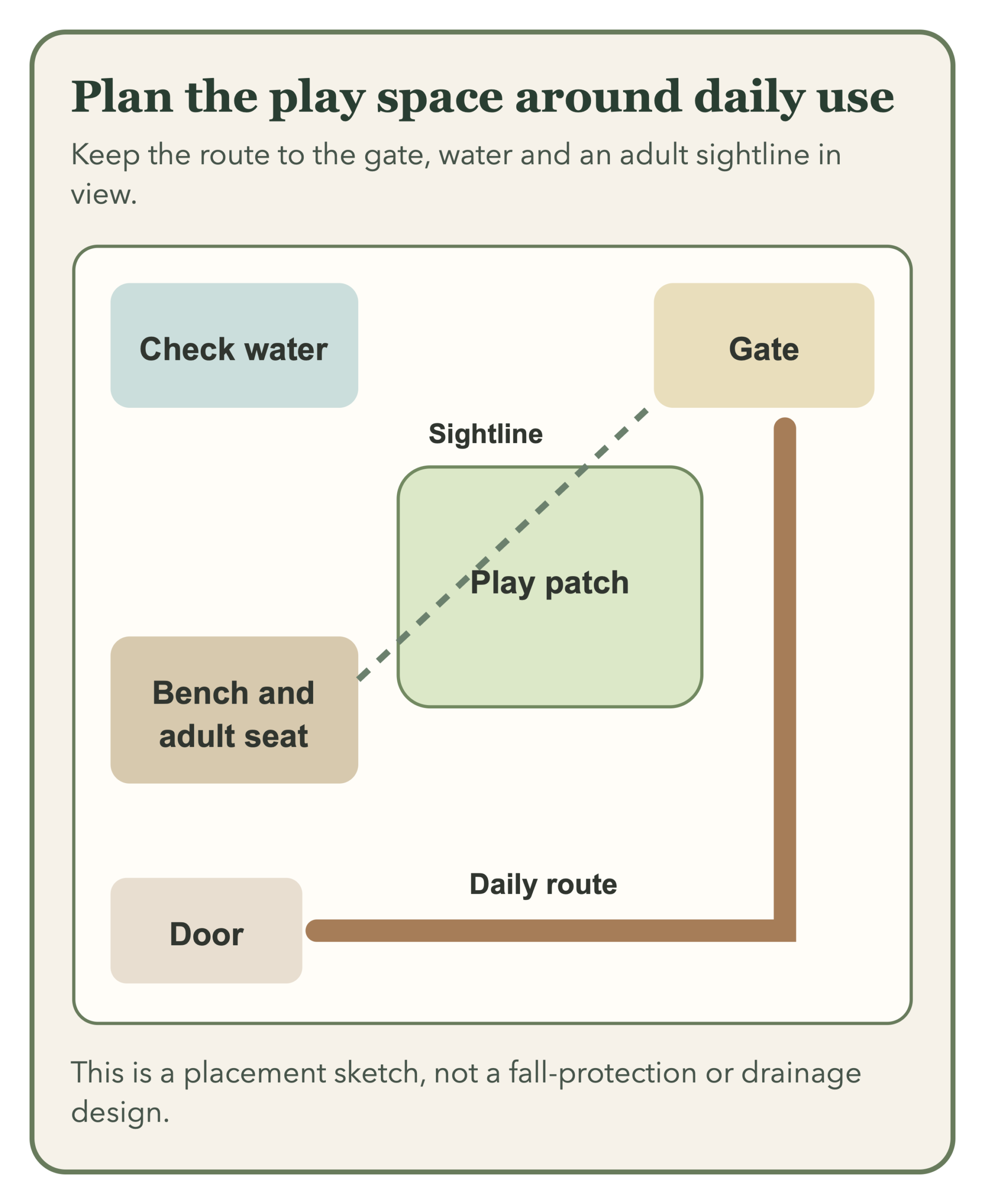
The sketch rules things out quickly. If the gate swings into a play spot, or your seat can’t see it, move the activity rather than squeezing it in. A self-closing, self-latching gate with the latch out of a small child’s reach is one of the most useful upgrades in any family yard.
Divide a small yard into move, messy, and quiet play
Give the biggest open patch to running, put messy play where the hose reaches, and keep one calmer edge for books, chalk or a pot to water. These are activities that take turns in the same few square feet, not three permanent installations.
| Zone | Typical size and setup |
|---|---|
| Move | The largest open patch, ideally 8 by 8 feet or more, on grass or a soft mat. Nothing that swings or rolls should cross it. |
| Messy | About 4 by 6 feet near the hose: sandbox, mud kitchen or water table, on gravel or pavers that drain. |
| Quiet | A shady edge of 3 by 5 feet or so with a cushion, a basket of books or a chalk panel, close to the adult seat. |
A washable mat might hold water painting in the morning and roll away before a ball game. Keep sand and water play well away from anything that swings or slides. If grass keeps turning to mud, plan a grass-free small backyard around drainage and a surface that suits each activity.
Interlocking foam or rubber pads are fine for crawling and block play at ground level. They are not fall protection, so keep them away from anything a child can climb.
For garden play, child-sized tools with rounded edges suit ages 3 to 6. Metal tools with sharper blades often carry an older age label, so read it before handing a set to a toddler.
Keep play equipment proportionate to the yard
Play equipment takes far more ground than it looks. CPSC guidance for home playgrounds calls for at least 6 feet of open space in every direction around most equipment, and for a swing, twice the height of the top bar in front and behind. A swing set with a 7-foot top bar therefore needs roughly 14 feet clear in front and 14 feet behind, about 35 feet front to back once you add the frame, which is more than many small yards have in total.
That space also needs a proper surface. Grass, packed dirt and concrete don’t cushion a fall; the usual recommendation is at least 9 inches of wood chips, mulch or shredded rubber, topped up as it compacts. If the yard can’t give a climber or swing that much room and surfacing, choose ground-level play instead, and save the swings for the park.
This is the one place to be strict. Before buying any climber, slide or swing, match the age label to your child, read the model’s full use zone and surfacing needs, check the CPSC recalls list, and follow the maker’s assembly and anchoring instructions exactly. Renters should ask the landlord before anything gets anchored into the ground.
| Ask about each item | Buy it when |
|---|---|
| Daily use | Children will reach for it most days, not just on birthdays. |
| Supervision | You can see it from your seat, with no blind corner behind it. |
| Reset and weather | It packs away or covers up in under 5 minutes and handles rain. |
| Age fit | The age label fits your child today, not in 2 years. |
| Space it takes | Its full use space still leaves an adult seat and a 36-inch way to the gate. |
Water deserves its own line: a toddler can drown in 1 to 2 inches of water. Empty kiddie pools, buckets and water tables after every use, and keep rain barrels firmly lidded.
Add shade and adult seating without blocking supervision
Put one comfortable seat where an adult will actually want to stay, then check what you can see from it at sitting height. Shade makes that seat pleasant, but a canopy, umbrella or tall planter should never hide the gate or pinch the way to the door.
Sun is strongest between about 10 a.m. and 4 p.m., which is often prime playtime. Watch where shade falls at the hours your kids are usually outside, and set the play patch and the chair in it together. A 9-foot patio umbrella shades a circle roughly 7 feet across; a 10 by 10 canopy covers the chair and the play mat at once. To reserve adult seating in a small backyard, claim that spot before adding more play gear.
For longer-term shade, a small tree such as a serviceberry or Japanese maple reaches about 15 to 25 feet and stays in scale with a small yard. It will take 3 to 5 years to give real shade, so lean on the canopy in the meantime.
Let the plan change as kids grow
Pick at least one part of the yard that can switch jobs every couple of years. The sandbox that suits a 2-year-old can become a raised vegetable bed by age 6, and the storage bench keeps working as a seat the whole time.
Toddlers want to pour and dig close to you. Kids from about 5 to 8 want room to run, a goal to kick at and a corner of their own. Older children often want a hammock or a spot to sit with friends. Movable pieces let the yard follow along without tearing anything out.
Once a week, spend 10 minutes on a reset: toys back in the bench, sandbox covered, standing water tipped out, and a glance from your chair to check the gate and play patch are still in view. Skip it for a month and the toys take over.
FAQ
How can I make a small backyard fun for kids?
Give them one open patch of about 8 by 8 feet and rotate a few simple activities through it. A covered sandbox, a chalk panel and a washable mat offer plenty of variety, and most families can set all three up for under $250.
What should go in a small backyard play area?
Room to move, a spot for messy play, a quiet corner, storage and one adult seat. Add bigger equipment only if its full use space, at least 6 feet in every direction, still leaves a clear way to the gate.
How do I make a backyard play area safer?
Start with a self-latching gate, no standing water, and play spots you can see from your seat. Keep climbing equipment off grass and concrete, over at least 9 inches of loose fill, and follow the maker’s instructions and age label. Active supervision matters more than any product.
How can a small backyard work for kids and adults?
Let play share one patch at different times, and keep an adult seat and some planting off limits to toys. A storage bench about 48 inches long clears the yard in a few minutes when playtime turns into dinner.
What should I check before buying backyard play equipment?
Check the age label, the full use zone and the surfacing it needs, then measure that whole area in your yard with stakes and string. Look the model up on the CPSC recalls list, and read the assembly and anchoring requirements before you order.
Final thoughts
Keep the play area where you can see it from your chair, and keep it small enough to tidy in 5 minutes. Movable pieces and a clear way to the gate do most of the work, and they adapt as your kids get older.
This weekend, sketch the door, gate, any water and your favorite seat, then mark one 8 by 8 foot play patch you can see from it. Before you buy anything that climbs or swings, review the CPSC home-playground safety handbook and measure its use zone in your own yard.
Last update on 2026-10-01 / Affiliate links / Images from Amazon Product Advertising API