
The best small backyard ideas for dogs start with the path your dog already runs: back door, gate, fence line and toilet spot. Keep that path open and about 3 feet wide, put a washable landing of pavers or a rubber-backed mat at the door, give the toilet corner a surface you can rinse (a 4 by 6 foot patch of pea gravel works for most small and medium dogs), and set water in a spot that stays shaded through the hottest hours.
Most small dog yards fail in the same place: the muddy strip between the back door and the gate. Your dog crosses it ten times a day, and no pretty planter fixes that.
Sort out that strip, a rest spot and a toilet corner first. Everything else, from seating to planting, fits around the edges once the daily trips work.
Recommended products for a small dog backyard


Recommended blogs
- Muddy small backyard ideas
- Small backyard ideas without grass
- Small townhouse backyard ideas
- Small backyard ideas for kids
- Small backyard makeover
12 family-friendly ideas with breathing room
These twelve looks share a small yard between a dog and the people who live with it. None of them needs the whole space. Pick the one that fixes your yard’s most annoying daily problem, then add a second only if there’s room left.
I’d keep the dog’s main running line clear first and let the decorative pieces gather around it. If the dog can do laps without crashing into a chair, everyone relaxes.
1. Moveable play patch
A rectangle of interlocking outdoor rubber tiles or a roll of pet turf, around 6 by 8 feet, marks out a play spot without committing the whole yard to one surface. It’s a natural fit for renters and paved courtyards, because you can lift it, hose it and move it.
Interlocking rubber tiles, usually 12 by 12 inches and about 3/4 inch thick, give paws some cushion. The catch is the seams: grit and water collect underneath, so lift and rinse the patch every few weeks in wet months.
2. Chalk surface by seating
A freestanding outdoor chalkboard, roughly 2 by 3 feet, set beside a bench gives children something to do while the adult on the bench can see both the dog and the gate. It needs one dry, hard edge of the yard, such as a patio corner.
Keep the chalk bucket on a shelf at least 30 inches up. Puppies and chewers treat dropped chalk as a snack, and the dust tracks indoors on wet paws.
3. Low sensory planting
Three wide planters, 20 to 24 inches across, filled with soft, dog-safe foliage such as Boston fern, calathea in shade, or rosemary and basil in sun, make a busy yard feel quieter. Set them at least 2 feet back from the main running line so tails and shoulders don’t strip the leaves on every pass.
Light pots get shoved around. Heavy glazed or concrete pots of 40 pounds or more stay put when a dog leans on them.
4. Washable picnic corner
A folding outdoor polypropylene rug, about 5 by 7 feet, two floor cushions and a tray turn a quiet corner into a lunch spot that packs away in five minutes. Put it near the house on even, dry ground, out of the line the dog uses to reach the gate.
Polypropylene rugs hose clean and dry in an afternoon. Cushions are the weak point if your dog chews fabric, so bring them in when the meal ends.
5. Toy storage beside the wall
A resin deck box of about 50 gallons, which is usually around 45 inches long and 2 feet deep, holds balls, leads, a towel and a frisbee against a blank wall. Leave enough space in front to lift the lid all the way without moving a chair. A 50-gallon resin box usually runs $60 to $120.
A lockable lid matters more than it sounds: some dogs learn to nose a lid open. Even “waterproof” boxes can let in a little driving rain, so keep towels in a sealed bag inside.
6. Shade tent on open ground
A pale fabric canopy or raised pet shade on the yard’s sunny open patch gives the dog an obvious place to flop, with the water bowl just outside the opening. In a new-build yard with no trees, this is often the fastest way to get shade, and most pet canopies cost $30 to $80.
It does take play space, often 4 by 4 feet or more. Stake it well, since lightweight canopies can lift in gusts over 20 mph, and check that the shadow falls where the dog lies at 3 p.m., not just at noon.
7. Simple loop for movement
A circuit around one open center, such as a lawn patch or a ring of planters, lets an active dog run laps while the middle stays usable. Keep the loop at least 3 feet wide so the dog can turn without clipping plants.
Follow the line your dog already wears into the grass rather than drawing a pretty circle it ignores. A loop squeezed tight against the fence tends to turn into a dusty track within a season.
8. Small mud-kitchen station
A compact mud kitchen, about 3 feet wide, on a patch of washable pavers gives children a messy corner away from the dog’s running line. A raised shelf and a lidded tub keep spoons and pots off the ground between sessions.
Expect the dog to want in. Skip small parts it could swallow, empty any standing water at the end of play, and only run it when an adult is out there too.
9. Easy-clean pet landing
A landing of pavers about 4 by 4 feet outside the back door gives you a place to stop, towel off paws and clip on a lead. Add a rubber-backed paw mat, a hook for the towel and a water bowl, and most of the mud stays outside.
Textured concrete or tumbled pavers grip better than smooth tile when wet. Make sure the landing slopes away from the house, around 1/4 inch per foot, so rinse water doesn’t run back to the door.
10. Digging box by the fence
A low timber or plastic sandbox, about 3 by 4 feet and 10 to 12 inches deep, gives a keen digger one approved place to excavate. Bury a few toys in it to teach the dog where digging pays off, and your borders get a break.
Fill it with washed play sand rather than garden soil, and keep a lid or tarp for rainy days and neighborhood cats. Sand travels, so expect a weekly sweep around the edge.
11. Calm retreat under cover
A raised cot-style bed, a water bowl and one sturdy planter under a porch roof or pergola make a settled corner for an older dog. Raised mesh beds, usually 6 to 9 inches off the ground, let air move underneath and dry fast after a shower.
Keep it within sight of a window. Roofs over hard paving can trap heat in summer, so feel the floor at the warmest part of the day before you commit to the spot.
12. Backyard dogs in everyday life
A bistro table for two, one fenced-off planted edge and an open run past both often works better than a yard chopped into separate pet and people zones. Dinner and fetch happen in the same space, just not at the same time.
The trick is restraint. Fewer loose cushions and lightweight chairs means fewer things knocked over, and the water, shade, gate and cleanup bag stay within a few steps.
Start with the dog’s entry, movement, and toilet path
Your dog has already designed half the yard. Spend two or three days watching where it goes: door to gate, along the fence, to the toilet corner and back. Worn grass and muddy streaks show you exactly which strips must stay open.
Draw the daily pattern
On a quick sketch, mark the back door, gate, toilet spot, water bowl, favorite shade and any lookout point where your dog watches the street. Circle bare patches and anywhere water sits for more than a day after rain. You don’t need measurements yet; you just need to see which jobs pile up on the same few square feet.
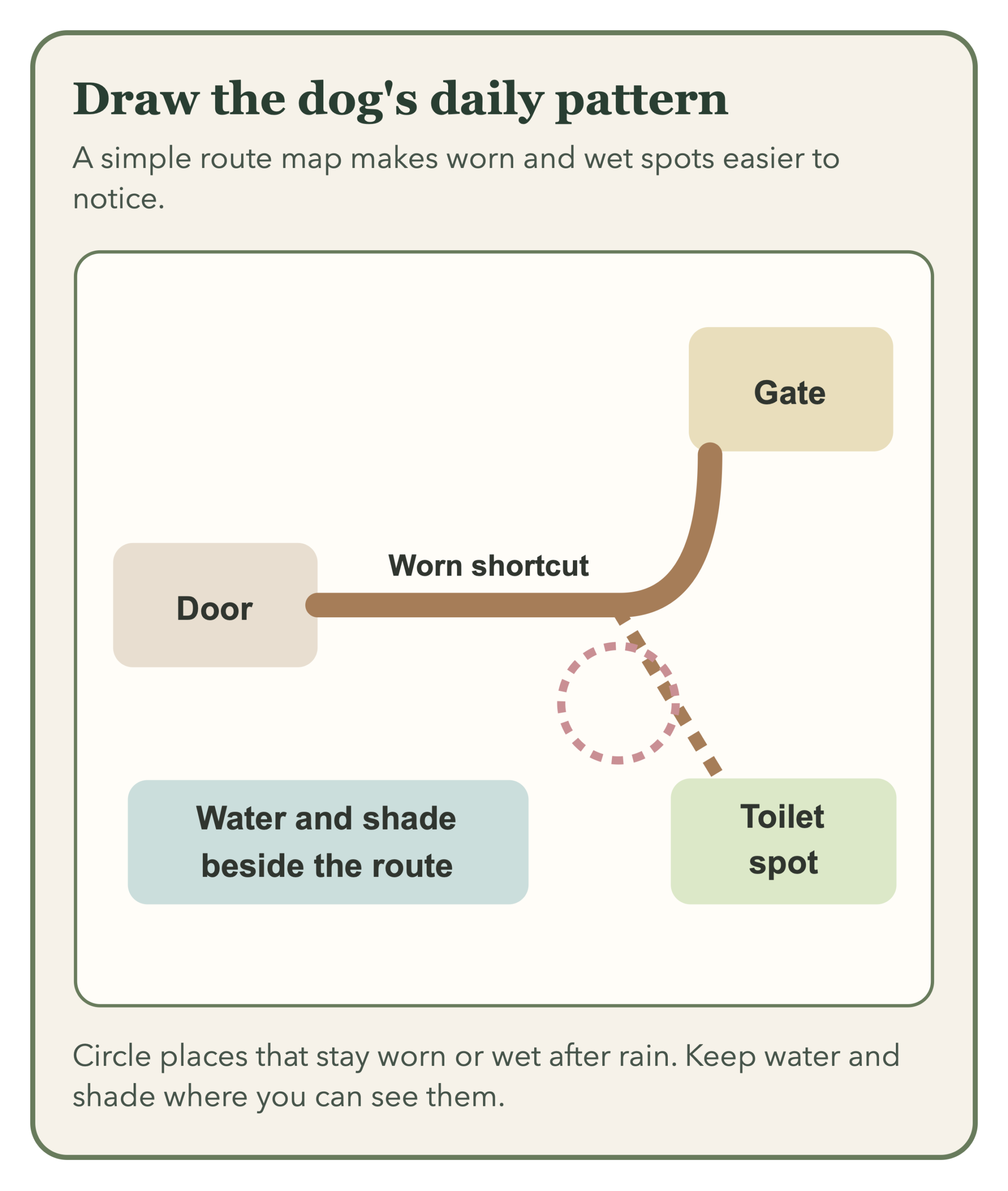
Many dogs also run a fence line, wearing a strip 12 to 18 inches wide where they patrol. Rather than fighting it with plants, turn that strip into a gravel or mulch run and move the border 2 feet in. As dog run ideas for small backyards go, it’s about the cheapest, and the dog was going to run there anyway.
Once the dog’s lines are clear, give what’s left to seating and planting. Try to send a dog around a new flower bed and you’ll usually end up with a bare track straight through the middle of it.
Choose surfaces for paws, cleaning, heat, and water
Give each job its own ground instead of one finish everywhere. The doorway takes muddy traffic, the toilet corner needs rinsing, and the rest spot needs to stay cool. A few surfaces in the right places beat one expensive material laid wall to wall.
Compare the work each surface asks of you
| Ground choice | Where it earns its place, and what it costs you |
|---|---|
| Existing grass | Coolest underfoot and cheapest to keep, but dog urine leaves yellow spots and a busy dog wears bare tracks. Tall fescue and Bermuda handle traffic better than most lawn grasses. |
| Pavers or a washable landing | Best for doorways and the main path. Easy to hose, but dark pavers get hot in full sun, and joints collect hair and grit. |
| Pea gravel | A good dog potty area surface: urine drains straight through and solids lift off easily. Use rounded 3/8 inch stone about 3 inches deep, and skip it for dogs that eat stones. |
| Artificial turf | Green all year where grass gives up, usually $2 to $5 per square foot for pet turf. It can get far hotter than grass in sun and needs weekly rinsing and an enzyme cleaner to control odor. |
| Mulch or planted ground | Fine for protected edges away from the running line. Use shredded wood or pine bark, refresh it once a year, and never use cocoa bean mulch, which is toxic to dogs. |
Test any hard surface with the back of your hand. If you can’t hold it there for 7 seconds, it’s too hot for paws. On an 85°F afternoon, dark pavers and synthetic turf in full sun can easily climb well past 120°F, while shaded grass stays close to air temperature.
A washable landing cuts down tracked mud, but it won’t fix water pooling underneath. If the grass is already failing across the whole yard, choose a grass-free small-backyard surface by the job each part of the yard does. With no grass backyard ideas for dogs, I’d give the toilet corner, the path and the rest spot different materials rather than one for everything.
Keep cleanup simple: pick up waste daily, hose the toilet corner once or twice a week in warm weather, and add an enzyme cleaner if odor lingers. If a surface is cheap but miserable to clean, you’ll pay for it in time every single week.
Give a small yard a resting shade zone
Every dog-friendly backyard needs one spot where the dog can lie down in shade, drink and still see you, without blocking the way to the gate. Watch the shade at the hours your dog is really outside. A corner that’s cool at breakfast can be in full sun by 2 p.m.
For a small to medium dog, a shaded patch about 4 by 4 feet is plenty. A tree, a pergola, a shade sail or a pet canopy all work; the shade just has to land there during the hottest 3 or 4 hours of the day.
Keep water close to the place they pause
Put the bowl in the shade, near a hose or the back door so refilling takes ten seconds. Dogs drink roughly an ounce of water per pound of body weight a day, more in heat, so a 40-pound dog can empty a 1-quart bowl by midafternoon. Use a bowl of at least 2 quarts outside, and rinse it daily to keep slime and mosquito larvae out.
An outdoor bowl stand keeps water off the dirt and is easier on the neck of tall or older dogs; set the rim at about the height of the dog’s lower chest. Pick a stand with a wide, heavy base so it doesn’t tip on gravel or grass.
Flat-faced breeds, older dogs and heavy-coated dogs overheat faster. On days above about 85°F, keep outdoor time short and in the shade, and call your vet if your dog pants heavily, drools thickly or seems wobbly.
Keep plants, gates, and storage out of trouble
Get down to nose height before you plant anything. Whatever sits within 2 feet of the ground near the dog’s running line will be sniffed, brushed against and probably chewed at some point.
Check what is reachable
Dog-friendly backyard landscaping starts with knowing every plant by name. Sago palm, azalea, oleander, foxglove, lily of the valley and yew are all on the ASPCA’s toxic list for dogs and are best left out of any dog yard. Look up anything you’re unsure of in the ASPCA plant database before it goes in, and keep slug bait, fertilizer and weed killer locked away; your vet or the ASPCA Animal Poison Control line can help if something gets eaten.
Then check the fence and gate. Most dogs are held by a 4-foot fence; jumpers and large breeds usually need 5 to 6 feet. Gaps under the gate should be smaller than about 2 inches for small dogs, and diggers may need a strip of buried wire or pavers along the base. A self-closing gate with a latch set high on the outside stops a gate left ajar by a visitor.
If you share fences with neighbors, plan a townhouse backyard around shared boundaries and walk the whole fence line, including the panels on their side you rarely look at. Loose boards and gaps behind sheds are where small dogs slip out.
Store tools, chemicals and toys in a lockable box or shed. A 50-gallon deck box keeps balls and leads tidy, and a locking lid stops a curious dog from climbing in or pulling things out.
Make the plan work when the yard is wet
Walk the yard again an hour after a good rain. Look for water crossing the doorway, sitting in the toilet corner or running toward the gate. That walk tells you where a clean entry will help and where the water itself is the real problem.
Keep one usable way through
For the door-to-gate strip, a line of 16 to 24 inch stepping pavers or a 3-foot band of gravel keeps paws out of the worst mud. At the door, a rubber-backed paw mat around 2 by 3 feet catches most of what’s left, and you can hose it off in a minute. Keep a towel on a hook beside it.
If water stands for more than 24 hours, comes back after every shower or runs toward the house or a neighbor’s yard, hold off on new surfaces. First diagnose a muddy small backyard before adding a surface. Persistent drainage trouble near a foundation is worth an hour of a landscaper’s time before you spend on materials.
Want a broader reset rather than a dog fix? A full small backyard makeover lets you plan paths, planting and seating together, and families with kids and dogs can borrow ideas from small backyard ideas for kids, since toddlers and puppies wear a yard in similar places.
FAQ
How can I make a small backyard better for a dog?
Keep the dog’s main path open and about 3 feet wide, add a shaded rest spot with fresh water, and give the toilet area a surface you can rinse. Then use the leftover space for seating and planting.
What surface works best for a dog in a small backyard?
A mix usually works best: pavers at the door, rounded pea gravel in the toilet corner and grass or shade for resting. Pea gravel drains fast and pavers hose clean. Synthetic turf suits yards where grass won’t grow, but it runs hot in full sun.
How do I create a dog potty area in a small yard?
Start where your dog already goes, if it’s practical. A patch of about 4 by 6 feet covered with 3 inches of rounded pea gravel suits most small and medium dogs, and a border of edging keeps the stones in place. Pick up waste daily and hose it weekly.
How do I keep a small dog yard from getting muddy?
Cover the strips your dog uses most with gravel or pavers, and put a paw mat at the door. If the same patch stays wet for more than a day after rain, fix the drainage first, because a new surface laid over standing water fails quickly.
What should I check for dog safety in a backyard?
Check the fence height (4 feet for most dogs, 5 to 6 for jumpers), gaps under the gate, shade and water on hot days, plant names against the ASPCA toxic list, and where garden chemicals are stored. Ask your vet about anything specific to your dog’s age or breed.
Final thoughts
Your dog has already shown you where the paths go. Keep those open and fix the muddiest strip first. The chairs and planters can wait.
After the next rain, walk the yard with a notepad, mark the wettest strip and the hottest patch at 3 p.m., and fix just those two this month. Before adding new plants or garden products within reach, review ASPCA guidance for a pet-safe garden.
Last update on 2026-10-01 / Affiliate links / Images from Amazon Product Advertising API