
A small patio makeover before and after starts on paper, long before you open a store’s website. Draw the patio at 1 square per foot, pick the one job it must do, then tie every change to a problem in the before drawing. On a 9 by 11 foot patio, moving one chair out of the door swing and clearing a 3-foot path to the yard does more than any new cushion.
A chair can look neatly placed and still stop the back door from opening all the way. Cushions can sit in an open tote and soak up every rain shower. Those small snags are what make a patio feel cramped, and most of them cost nothing to fix.
The example that runs through here is a 9 by 11 foot patio with two chairs, one planter and a door that swings out. Every change is drawn at the same scale, so the after plan can’t cheat by looking roomier than it is.
Recommended products for a small patio makeover


Recommended blogs
- Small patio ideas
- Small patio ideas on a budget
- Small concrete patio ideas
- How to measure patio for furniture
- Small backyard makeover
15 fresh ways to reimagine a small patio
Each of these is a before-and-after you can picture from the doorway: one starting problem, one clear change, and the thing you’d notice first in an after photo taken from the same spot. Most need no tools, and the ones that do say so.
1. Bright café corner
Before: a dull corner with two mismatched chairs. After: one butter-yellow folding café chair, a 24-inch white table, a blue-striped cushion and one leafy pot. It folds flat in a minute when you need the floor, which suits a patio used mostly for morning coffee.
Painted metal chips and pale tabletops show pollen, so expect a quick wipe most weeks in spring. A pair of folding bistro chairs usually runs $60 to $150.
2. Tonal terracotta edge
Before: five small pots scattered along the edge. After: the healthiest existing planter plus two or three terracotta pots grouped tightly beside it, with the clay color repeated in a rust cushion. The close palette makes separate pieces read as one planting.
Set the empty pots out first to check the floor stays open around them. Use saucers or pot feet, because terracotta leaves rings on concrete, and in zones 6 and colder move unglazed clay under cover for winter so it doesn’t crack.
3. Warm slatted backdrop
Before: two chairs against a bare wall or chain-link fence. After: a warm wood-tone slatted screen about 5 to 6 feet tall behind them, with cream seat pads and one broad-leaved pot. The furniture stays put; only the background changes.
Slats soften a view rather than blocking it completely. A freestanding screen usually runs $60 to $200, and anything that tall catches wind like a sail, so weight or anchor its feet before the first gusty day.
4. Removable deck-tile grid
Before: patchy, stained concrete. After: a grid of 12-by-12-inch interlocking wood or composite tiles under charcoal folding chairs and one pale pot. Tiles usually run $3 to $8 each, so a 6 by 8 foot sitting area needs 48 tiles.
They add about an inch of height, so stop them short of the door threshold and leave a gap where water runs off. Lift and sweep under them each spring and fall. They cover stains, not cracks or a slab that holds water.
5. Gravel-and-paver sitting room
Before: a patch of worn lawn or bare dirt off the patio. After: a rectangle of pale gravel with 16-inch square pavers, low natural-wood chairs, a sage cushion and two big pots. Keep any established shrub at the edge rather than clearing for symmetry.
This is real ground work: dig about 4 inches, lay compacted base and add steel edging so gravel stays put. Call 811 a few days before digging. Loose gravel is hard on wheels and unsteady feet, so keep pavers on the main way through.
6. Charcoal and natural wood
If a mix of dark pieces looks heavy together, keep only the best charcoal chair and pair it with a small natural-wood table, a striped cushion and one dark planter. Two colors, one new purchase, and the doorway suddenly looks cleaner.
Keep the wood to the smaller piece. Acacia and teak need oiling once or twice a year to keep their color, or they weather to silver gray.
7. Mediterranean white and green
Before: too many unrelated colors in a sunny spot. After: white and leafy green take the lead, with one terracotta pot, washable cream cushions and a simple painted table. One small blue detail is plenty. Add three and it starts to look like a theme.
Test it with textiles and pots before you paint anything. Rosemary, lavender and olive in pots love 6 or more hours of sun. White fabric shows every speck of soil, so pick covers you can unzip and machine wash.
8. Painted geometric wall
Before: serviceable furniture against a flat, plain wall. After: a clay rectangle or soft peach arch painted behind one dark chair, echoed in a small pot. The floor and furniture stay as they were, so the shape does all the work.
Tape a full-size paper outline first and look at it from the door for a few days. Exterior masonry paint usually runs $30 to $60 a gallon, and a quart covers an arch this size. Paint won’t hide damp or cracks for long, and a bold shape dates faster than a cushion.
9. Petite doorway breakfast nook
Before: a bulky table no one sits at. After: a 24 to 30 inch round table and the two best chairs, with blue-and-cream cushions and one herb pot set outside the door swing. It suits one or two people who really do eat outside.
Each seated person needs about 24 inches of width and roughly 2 feet behind the table edge to pull a chair out. Tape that out, open the door fully, and walk past before you buy.
10. Layered vertical garden
Before: a row of small pots eating floor space under an empty wall. After: two favorites stay on the ground and the rest move to a freestanding 3 or 4 tier stand, mixing trailing and upright plants in green, cream and terracotta.
A watered 10-inch pot can weigh 10 to 15 pounds, so load the bottom shelf first and stop if the stand wobbles. Put it where drips won’t land on a neighbor’s balcony or your doormat.
11. Low warm evening light
Swap the glare of one harsh porch bulb for a battery table lamp and a lantern by the seating edge, both warm white around 2700K and both off the walking line. Amber light flatters charcoal furniture and terracotta.
Outdoor battery lamps usually run $25 to $60 and last 6 to 12 hours a charge. Check the IP rating on the box: IP44 handles splashes on a covered patio, while an open patio wants IP65 or higher.
12. Light woven screen
Before: a solid dark divider that boxes the patio in. After: a pale woven or open-pattern panel, oat cushions and a loose ornamental grass at its base. The lighter texture breaks up the boundary and still lets some light and air through.
Place it to hide one specific view, then sit down and check. If it narrows the way out or shades your only sunny chair, it’s solving the wrong problem. Resin wicker outlasts natural rattan outdoors by years.
13. Bench-led storage wall
Before: loose cushions and a plastic tote along one wall. After: a slim natural-wood or soft-gray storage bench, one long cushion and a tall pot. The practical wall finally looks planned.
Measure three things: the outside size, the inside size against your actual cushions, and the lid fully open. Compact storage benches usually run $80 to $200. Most are water-resistant rather than dry, so slip cushions into breathable bags inside.
14. One defined rug zone
Before: three small mats that make the floor look busy. After: one rust-and-cream outdoor rug, about 5 by 7 feet, gathering the chairs and table, with rust repeated in a single pot. On a 9 by 11 foot patio that leaves about 2 feet of bare floor around most edges.
Keep it out of the door arc and off any crack you’re watching. Polypropylene rugs usually run $40 to $150; lift and hose them after heavy rain so the concrete underneath can dry.
15. Indoor colors carried outside
When the patio beyond a glass door feels unrelated to the room behind it, borrow one indoor color (deep green, faded blue or ochre, say) and repeat it in a cushion, a pot and a small tabletop piece. Nothing moves. The step outside just feels shorter.
Stand inside and pick the color your eye lands on first. Use outdoor fabric for anything that stays out, since indoor cotton fades and holds damp within a single summer.
Start with an honest small-patio baseline
Before you move a chair, write down what can’t move. University of Maryland Extension’s landscape planning advice starts the same way: list existing features, access, utilities, sun and wind, wet areas and realistic goals. On a patio, the door and threshold matter as much as the furniture.
Record access, thresholds, drainage, exposure, damage, storage, and permissions
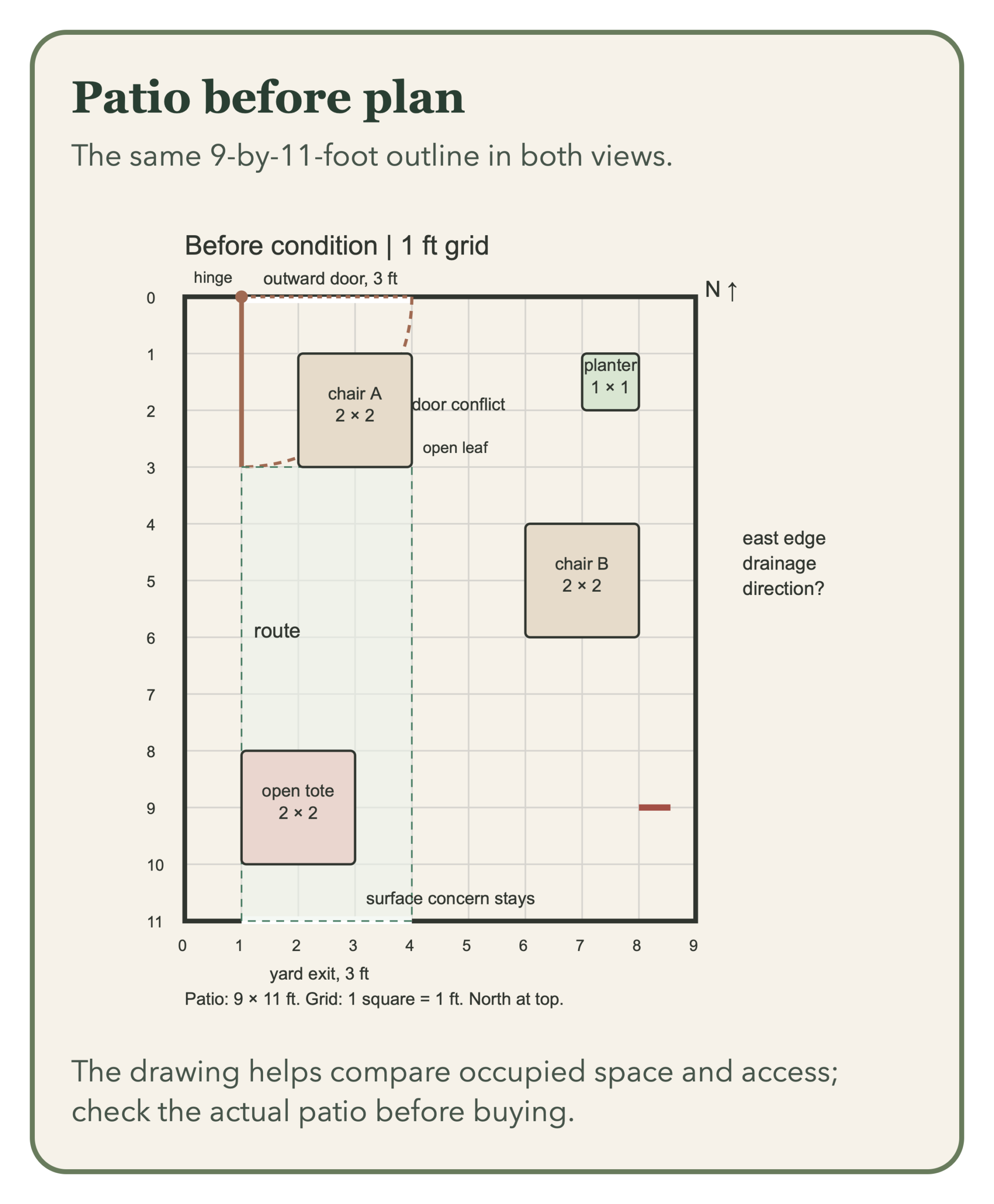
The example patio is 9 feet east to west and 11 feet north to south. A 3-foot door on the north edge swings outward, and a 3-foot opening to the yard sits opposite. In the before plan, one chair sits in the door swing and an open cushion tote narrows the way to the yard.
Mark the threshold and a worn patch on the east edge without guessing what caused it. To see where water goes, empty a bucket on the slab or watch after rain: a patio should drop about 1/8 to 1/4 inch per foot away from the house. Add the planter, the second chair, where cushions live, and the view toward the neighbor on the east side.
Renters should read the lease and get written approval for anything beyond moving furniture and pots; owners should check HOA rules before paint, screens or new paving. That one check up front covers every idea here.
Separate styling problems from repair or safety problems
A crowded path is a layout problem. A crumbling edge, water running toward the door, a loose railing or a scorched outlet is a repair problem. Note those plainly and get them looked at by a mason, landscaper or electrician before any rug, tile or planter goes on top.
Draw the before condition to scale
Keep the door, the edges and the yard opening fixed, even when they make the first drawing look awkward. One square equals 1 foot in both plans. Chairs are drawn at their 2 by 2 foot size, without people in them.
Label fixed edges, existing items, routes, and problem areas
The 3-foot door is hinged on its west side, and its quarter-circle swing crosses chair A. The open tote sits in the 3-foot strip meant for walking. The red mark on the east edge shows the patch to inspect; a drawing can’t tell you what’s wrong with the slab.
Decide what the new layout must accomplish
This patio gets one job: two people sitting comfortably while the door and the way to the yard still work. A dining set, screen, new floor and lighting can wait until that works.
Choose one primary use
Two chairs make sitting together the priority. A dining table for two needs about 6 by 6 feet once chairs are pulled out, so it gets its own test before it joins the plan.
Set testable success conditions before adding anything
Write the tests down before you move anything. The door opens fully. A 3-foot strip runs clear to the yard. Two people can sit down and get up without bumping knees. Cushions have a home they actually go back to. You can still reach the east edge to sweep and inspect it.
If meals matter more than lounging, compare small patio dining layouts first. Either way, test with your real door and chairs, since a 2-foot square on paper leaves out armrests, legs and the person sitting there.
Build the keep, move, repair, remove, and add list
Every change should answer a problem you can point to in the before plan. Owned items count as $0 in new cash, which isn’t the same as free. Leave repairs unpriced until you have a local quote, rather than guessing.
Record the problem, fix, cost, effort, care, and permission for each change
Each row says what changes, why, what it costs and what to check. Grid positions count feet from the west edge (x) and the north edge (y).
| Change | Why, cost and what to check |
|---|---|
| Keep: planter, 1 by 1 foot, at x 7 to 8, y 1 to 2 | Already out of the way in the northeast corner. $0 new cash; water and sweep around it. Check it drains and doesn’t tip in wind. |
| Move: chair A to x 5 to 7, y 3 to 5 | It blocked the door swing. $0, about 5 minutes. Open the real door fully with someone sitting in the chair. |
| Move: chair B to x 5 to 7, y 6 to 8 | Pairs the two seats east of the walking strip. $0. Test both chairs with people getting in and out. |
| Repair: east-edge patch | Damage or damp could make styling unsafe. Unpriced until inspected. Needs owner or landlord sign-off for any repair. |
| Remove: open tote, 2 by 2 feet | It narrowed the way to the yard and kept nothing dry. $0; cushions go indoors after use. Check there’s a closet or shelf for them. |
| Add: small table, 18 by 18 inches, at x 7 to 8.5, y 5 to 6.5 | Gives the chairs a spot for drinks. A small outdoor side table usually runs $30 to $80. Add only after the two-chair test passes. |
Draw the after plan at the same scale
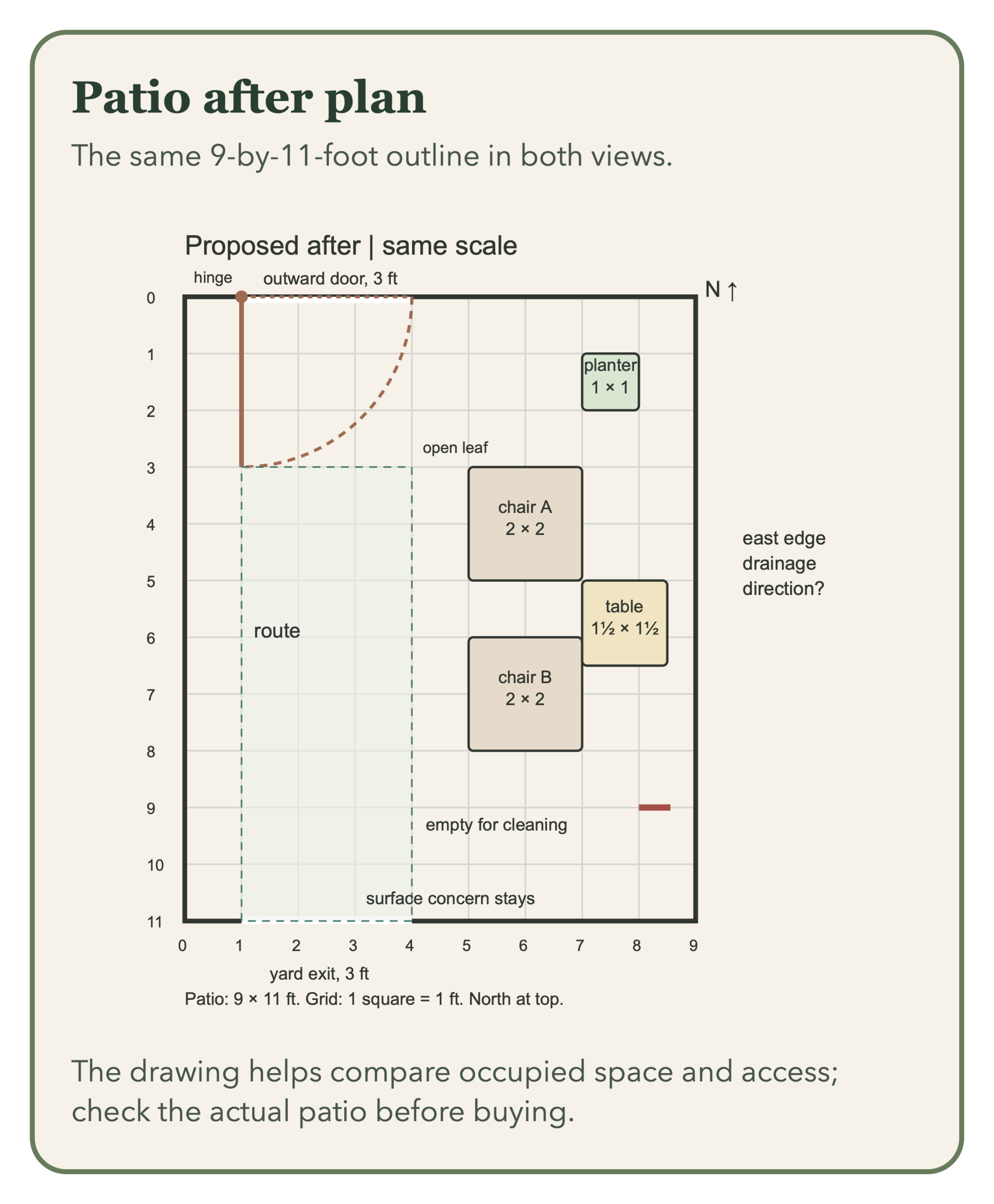
Keep the same outline and the same 1-foot grid as the chairs move. A wider crop or a lower camera angle can make a patio look roomier without giving anyone an extra inch to walk.
Show every piece, the clear way through, and deliberately empty space
Both chairs now sit east of the 3-foot walking strip. The table is pencilled in as optional, and the tote is gone because cushions go indoors. The east-edge mark stays. The empty floor beside it is there for sweeping and inspection, not a gap waiting to be filled.
Walk through each compact-patio change
Read the list top to bottom before calling the after plan better. Each change should fix one named problem without creating another, and the optional table always comes last.
Explain each decision in list order
The planter stays because it was never in the way. Chair A moves out of the door swing, which fixes the first daily annoyance. Chair B moves beside it so two people can actually sit together. The east-edge patch stays marked instead of disappearing under a rug.
Taking the tote away opens the way to the yard, but only works if cushions have somewhere indoors to go. The 18-inch table comes last, and only if both chairs are still easy to get into with it in place.
If real chair legs or a seated person spill into the walking strip, shift the chairs before thinking about the table. If carrying cushions inside every evening won’t happen, a storage bench or waterproof covers ($20 to $40 each) are the fallback, and a screen for privacy only joins the plan once you’ve checked it against wind.
Test the new arrangement against the starting problems
The 3-foot strip looks clear on paper once the tote is gone, but that’s only the first check. Open the door, sit in both chairs, carry the cushions in, and sweep the east edge. It takes about 10 minutes and settles more than any drawing.
Check access, seating in use, storage, cleaning, and maintenance
| Test | How to check it for real |
|---|---|
| Door opens fully | Swing the door all the way with both chairs occupied |
| Clear way to the yard | Walk the 3-foot strip carrying a tray or a bag of soil |
| Two usable seats | Two people sit, stand and swap without bumping |
| Cushion storage | Bring cushions in every evening for one week |
| Sun, wind and privacy | Sit there at the times you’d really use it |
| Cleaning access | Sweep the east edge without moving furniture |
Keep one unresolved tradeoff visible
Moving both chairs east frees the walking strip but puts the seats closer to the neighbor’s view. A 5 to 6 foot screen would fix that, though it might also shade the chairs, catch wind or crowd the table.
Leave privacy as an open question until you’ve sat there for a week at the times you actually use the patio. If the exposure comes from the side of the house, plan a small side yard makeover separately; moving these chairs can’t solve it.
Separate cosmetic wins from repair work
Scrubbing a sound slab, moving chairs, adding cushions, pots and portable lights can change how a patio feels in a single weekend for under $200. None of it mends broken concrete, turns water running toward the door, fixes wiring or steadies a railing.
Hairline cracks are usually cosmetic. Cracks wider than about 1/4 inch, edges that have lifted into a trip lip, or a slab that tilts toward the house are worth a contractor’s look. The small concrete patio ideas piece covers what to do with a tired slab once it’s sound.
Make the before and after honest
Use the same 9 by 11 foot outline and 1-foot grid in both views, and take photos from the same spot at the same height. Keep the east-edge patch, the unknown slope and the privacy question visible in the after plan until each one has an answer.
Record dimensions, costs, labor, permissions, and exclusions
A fair cost comparison covers the same scope on both sides and notes where and when you priced it. Count owned chairs at $0 new cash, then list the new table, tax, delivery and any hired help separately. Note gifts too, so the total isn’t flattered.
Leave inspection and repair unpriced until someone has scoped them. If repairs turn a weekend refresh into a bigger job, build a backyard makeover timeline before you fold the patio into it.
FAQ
How do you plan a small patio makeover before buying anything?
Measure the patio and draw it on graph paper at 1 square per foot, including the door swing and the way to the yard. Pick one main use, then write down the problem each change will fix. To measure furniture against the drawing, see how to measure a patio for furniture.
What makes the biggest difference in a small patio makeover?
Fixing whatever stops the patio from being used makes the biggest difference. On the 9 by 11 foot example, moving one chair out of the door swing and clearing a 3-foot path changes daily life more than any decor, and costs nothing.
How can I make an old concrete patio look better?
Clean it first: a rented pressure washer usually costs $50 to $100 a day and lifts years of grime from a sound slab. Then add one outdoor rug, a few large pots and warm light. Cracks over about 1/4 inch or water pooling by the door need fixing before anything covers them.
How do I compare before and after patio costs fairly?
Use the same scope for both totals and list every new item, tax, delivery and paid labor, with the date and town where you priced them. Count owned pieces at $0 new cash and say so. Leave unknown repair costs blank rather than writing $0. For low-cost swaps, small patio ideas on a budget breaks down typical prices.
Can renters do a small patio makeover without permanent changes?
Yes, and most of the biggest wins are renter-friendly: rearranging furniture, an outdoor rug, pots, cushions, battery lamps and interlocking deck tiles all leave no trace. Get approval for anything that drills, paints or attaches to a railing, and keep the door and exit clear.
Final thoughts
Honestly, the best small patio makeovers often look a bit underwhelming in photos. There are fewer things, they sit in better places, and each move fixes something that used to bug you. For more layouts to try once yours works, browse these small patio ideas, and for a bigger yard project, start with a small backyard makeover plan.
Tonight, sketch your patio on graph paper and circle the one thing that annoys you most. University of Maryland Extension’s advice to inventory the real site before finalizing a makeover is a good next read. When you draw your after, keep the same scale.
Last update on 2026-10-01 / Affiliate links / Images from Amazon Product Advertising API