
The best small covered patio ideas match the cover to the job. For an hour or two of harsh sun, a 9 to 10 foot umbrella is enough. For daily summer shade, use a shade sail or fabric canopy. For light rain, a retractable awning or a covered pergola works. Only for real all-weather shelter do you need a permanent roof, which usually means a permit. Watch where the sun hits your seat at three times of day, keep a 36-inch walkway to the yard, and pick the lightest cover that fixes the problem.
A small patio can look wonderfully sheltered in a photo and still feel cramped once a chair pulls out, or leave the living room dim all afternoon. Start with the hour you actually want to sit outside.
Often a little late-day shade over one chair does more for you than a roof over every square foot. And it costs a few hundred dollars instead of a few thousand.
Recommended products for a small covered patio


Recommended blogs
- Small patio ideas
- Small concrete patio ideas
- Small patio dining layout
- Small patio pergola ideas
- Small townhouse backyard ideas
12 shelter ideas that still feel open
On a small patio, the covers I like best shelter the seat and still let you see the sky. Pick the look once you know which hours need shade, where rain will run off, and how the door and chairs move.
1. A dark frame makes greenery glow
Charcoal or black posts and beams draw a crisp outline around broad leaves, pale cushions and terracotta pots. On a 10 by 10 foot patio that contrast does the decorating for you. Oddly, the garden beyond looks greener too.
Dark finishes show pollen and dust, and a wide dark beam right outside a window can make the room feel heavier. Tape a dark paint card to the glass and look out at it for a day before you commit.
2. Pocket shelter in one corner
Shade one chair and a side table instead of the whole slab. A cantilever umbrella with a 9 to 10 foot canopy can hang over that corner while its base sits off to one side, leaving the walk from the door completely open.
It suits a patio where only one seat catches the hard afternoon sun. Plan for the base, though: most cantilever bases are around 3 feet square once weighted, and they don’t move easily.
3. Shade that leaves with the season
Clip a removable fabric panel to an existing frame and it feels like a light canopy, not a roof. Stick to sand, faded sage or cream so the planting still gets noticed. The whole thing comes down in October and goes back up in May.
That twice-a-year job is the tradeoff. Fabric needs to be clean and fully dry before it goes into storage, or it mildews over winter, so allow an afternoon for each changeover.
4. Striped shade over the favorite spot
A narrow striped awning, 8 to 10 feet wide, above the chair you use most brings pattern overhead while the rest of the patio stays calm. It looks especially good against a plain wall with a simple pair of pots.
Because it extends and retracts, you get shade at 5 p.m. and full daylight at breakfast. It does fix to the house wall, which makes it an owner’s project or one that needs a landlord’s yes.
5. A breezy canopy with breathing room
A pale fabric canopy over two low lounge chairs softens the sun without closing in the sides. Keep the seats under 30 inches tall and let one big pot hold the edge, so air and your eye can travel past the seating.
It looks airy, but airy doesn’t mean storm-ready. Most fabric canopies are meant to come down in strong wind or heavy rain, so treat it as a fair-weather piece.
6. A pergola that frames the distance
Line up an open pergola so its posts and beams point at a tree, a planted border or the far corner of the yard. The repeated frame makes the view feel deliberate, and the gaps between rafters keep plenty of daylight reaching the house.
An open-top pergola filters sun; it doesn’t keep you dry. Each post also takes up about a 6-inch square of floor plus elbow room around it, so set the posts where nobody gets up from a chair.
7. Dinner sheltered along the wall
Run a slim table, about 24 to 30 inches deep, along the house wall under an existing eave or cover, and keep the garden side open. A long herb planter near the kitchen door adds scent and something to snip at dinner.
This works on a long, narrow patio where chairs on the outer side can pull back 24 to 36 inches without hitting the doorway. Watch for drips off the roof edge, and keep the downspout and any vents clear.
8. A little roof beside the seats
A compact freestanding roof, around 8 by 8 feet, beside a pair of chairs makes one end of the patio feel snug while the other end stays open to the sky. It shades far less of the window than a full-width cover would.
Small doesn’t mean simple. A solid roof sheds all its rain off one edge, needs solid footings and often a permit, so it belongs with the permanent options further down the list.
9. A climber curling around one post
Grow one climber from a large pot at the base of a post, trained up its own trellis or wire rather than straight onto the structure. Clematis, star jasmine in zone 8 and warmer, or a climbing rose soften a hard corner in a single season.
Use a pot at least 18 to 20 inches across; filled with damp soil it can easily top 80 pounds, so put it where it can stay. Keep growth out of gutters and moving parts, and expect to tie in new shoots every couple of weeks in spring.
10. An open frame that welcomes light
Sometimes a frame alone is enough to make the patio feel like a room. Pale cedar or an off-white finish marks the seating area, and the open top lets the living room borrow as much daylight as before.
Be clear-eyed about what you’re buying: a sense of enclosure, little rain protection and only patchy shade. Rafters running east to west cast more midday shade than ones running north to south.
11. Curtains drawn for a softer evening
One or two outdoor curtain panels on the west side of a pergola or covered patio turn low evening sun into a soft glow. Panels usually come about 50 to 54 inches wide and 84 to 108 inches long, and solution-dyed polyester ones commonly run $25 to $60 each.
Tie them back when you don’t need them so the garden stays in view. Loose fabric whips around in wind and grows mildew if it stays damp, so let wet panels dry spread out before bunching them up.
12. How shade shapes covered patio
Let the shadow decide where the outdoor room starts. Put the main chair inside the shade you already have, then brighten the sunny edge with a pale pot, a light cushion or sun-loving plants. Even on a patio 6 feet deep, you end up with a shady middle and a bright edge.
It costs almost nothing. You just have to watch the patio at the hours and in the month you care about, because a seat that’s shaded at 9 a.m. may be in full sun by 4 p.m.
Decide how much weather protection you actually need
Think of covers as a ladder. Climb only as high as your problem needs. Each step up costs more, bolts more things down and takes a little more daylight from the room.
Movable sun relief
If the seat is uncomfortable for only an hour or two, start with an umbrella. A 9-foot market umbrella usually runs $50 to $200 and casts a patch of shade roughly 7 feet across at midday; a cantilever model runs $150 to $500 and can tilt toward low sun.
Use the base weight the maker lists. A freestanding market umbrella typically needs 50 pounds or more, and cantilevers often call for 150 pounds or more, especially on a breezy patio. Close it whenever you walk away.
Seasonal fixed shade
When the same patch is sunny most afternoons, a shade sail or fabric canopy makes sense. A 10 by 10 foot square or 12-foot triangle sail usually runs $30 to $120 before hardware, and knitted shade cloth lets hot air escape so it feels cooler underneath than a solid cover.
Most sails are not rainproof; knitted fabric lets water through, and waterproof ones need a good tilt so rain runs off instead of pooling. Plan to take sails down before big storms and for winter wherever snow falls.
Partial rain protection
If you mainly want to carry a coffee outside in a light shower, think about where the water will drop. A retractable awning gives adjustable cover, but most fabric awnings are meant to be rolled in during heavy rain and gusty wind.
A pergola only becomes a rain cover when you add a solid or louvered roof made for that frame. Those systems keep you dry in ordinary showers but cost noticeably more than an open top.
A permanent roof
An attached roof gives dependable shelter year round. A small professionally installed aluminum or wood patio cover commonly runs $3,000 to $10,000 or more, depending on size, materials and local labor.
It also permanently shades the nearest window and sends every drop of rain off one edge. Patio roofs are usually pitched at least 1/4 inch per foot so water runs off, and that water needs a gutter or a place to go.
Make a three-time shadow clock
All you need is a quick sketch and three looks outside. On a day that feels like the season you care about, mark the seat, the nearest window and the edge of the shade at about 8 a.m., 1 p.m. and 5 p.m.
Record morning, midday, and late-afternoon exposure
Say you have an 8 by 10 foot patio facing west. Breakfast is pleasant, midday sun reaches the outer chairs, and from about 3 to 7 p.m. in summer the sun lands squarely on the seat. A movable umbrella by that seat is the obvious first try; a roof over the whole patio would darken the window even when nobody is out there.
| Time | What you see, and what it suggests |
|---|---|
| 8 a.m. | The seat is already comfortable. Keep the window open to morning light. |
| 1 p.m. | The outer chair starts to warm. Note how far the house shadow reaches across the floor. |
| 5 p.m. | The seat is in direct sun. Try a tilting umbrella or a west-side curtain at the seat first. |
Repeat it once in early summer and once in early fall if you can. The sun sits much lower in September, and shade that covers the chair in June can miss it completely by then.
Protect windows, doors, vents, and the indoor daylight line
Stand inside and look out the patio window before settling on anything permanent. Mark the door’s full swing, any dryer or furnace vents, downspouts and the walk to the yard on your sketch.
A cover that shades the seat but turns the living room dim at 2 p.m. has solved half the problem. Light-colored fabric, open rafters or a cover that stops a foot or two short of the window keeps more daylight indoors.
Compare cover types on the same small patio
Now draw each cover on the same sketch. Mark where its base or posts sit, where its shadow lands at the hour you need it, and check you can still walk from the door with a chair pulled out.
| Cover | What it does and what it takes |
|---|---|
| Cantilever umbrella | Movable sun shade that tilts with the sun; a weighted base about 3 feet square. Usually $150 to $500. |
| Shade sail or fabric canopy | Fixed seasonal shade, little or no rain protection; 3 or 4 strong anchor points. Usually $30 to $300. |
| Freestanding pergola | Filtered shade, a sense of a room; 4 posts on the floor. A 10 by 10 foot kit usually runs $600 to $3,000. |
| Retractable awning | Adjustable shade and light rain cover; fixed to the house wall. Manual models often run $300 to $1,200. |
| Attached roof | Real rain shelter; a fixed edge, gutter and often posts, plus a permit. Usually $3,000 and up installed. |
Cantilever umbrella: movable coverage and base space
Draw the base at its real size, then pull out the chair beside it. If you have an umbrella to borrow, move it around until its 5 p.m. shadow lands on the seat without the base sitting in the walkway.
The listed canopy size, usually 9 to 11 feet, only tells you how big the shade is, not where it falls. Low afternoon sun throws the shadow well off to one side, which is exactly why the tilt matters.
Shade sail or canopy: geometry, tension, wind, and rain limits
Put the sail’s corners on the drawing and compare its shape with your three sun marks. If it misses the hot chair or shades the window all morning, shift the corners on paper first; turning a triangle 30 or 40 degrees often fixes it.
Sails pull hard on every corner, so each anchor has to be strong enough for the tension the maker specifies. A gutter, a vinyl fence or a balcony rail is not an anchor. If you don’t have a solid post or wall at every corner, choose a different cover.
Freestanding pergola: posts, filtered shade, and circulation
Mark the four post positions before you fall for the overhead shape. A 10 by 10 foot pergola on an 8 by 10 foot patio puts at least two posts off the slab, and an 8 by 8 kit can leave a post right where someone stands up from a chair.
Most kits stand about 8 feet tall at the beams, which keeps the space feeling open. Slats spaced a few inches apart give dappled shade and keep the nearby room brighter than a solid roof would.
Retractable awning: adjustable coverage and attachment
Draw the awning’s wall line above the door and window, then its outer edge fully extended. A 10-foot-wide awning that projects 8 feet covers a small bistro set comfortably.
Being able to roll it back on cloudy days is the whole point, so it suits rooms that already feel a little dark. The wall has to carry the weight and the leverage of the arms, which is a job for an experienced installer.
Attached roof: drainage, loads, and approval
Trace the roof edge and follow the rain from it to somewhere it can soak away. A 10 by 10 foot roof sheds roughly 60 gallons in a 1-inch rain, so that water needs a gutter and a downspout aimed away from the door, the foundation and the neighbor’s yard.
Mark the permanent shadow on the window too. If the room already relies on that window for most of its light, a translucent polycarbonate roof keeps more of it.
Fit the furniture rectangle after the cover
Draw the space a table and pulled-out chairs actually use, then place the base or posts around it. A 30-inch bistro table with two chairs needs an area of roughly 6 by 6 feet once the chairs slide back. To compare a small patio layout, start with the seat you use most and the clear way past it.
Keep the way from door to yard open
The 8 by 10 foot sketch splits the patio into a 3-foot walking strip from the door to the yard and a 5-foot strip for furniture. Try it for real: open the door, pull out a chair and carry a full watering can through. Widen the walkway anywhere you have to turn sideways.
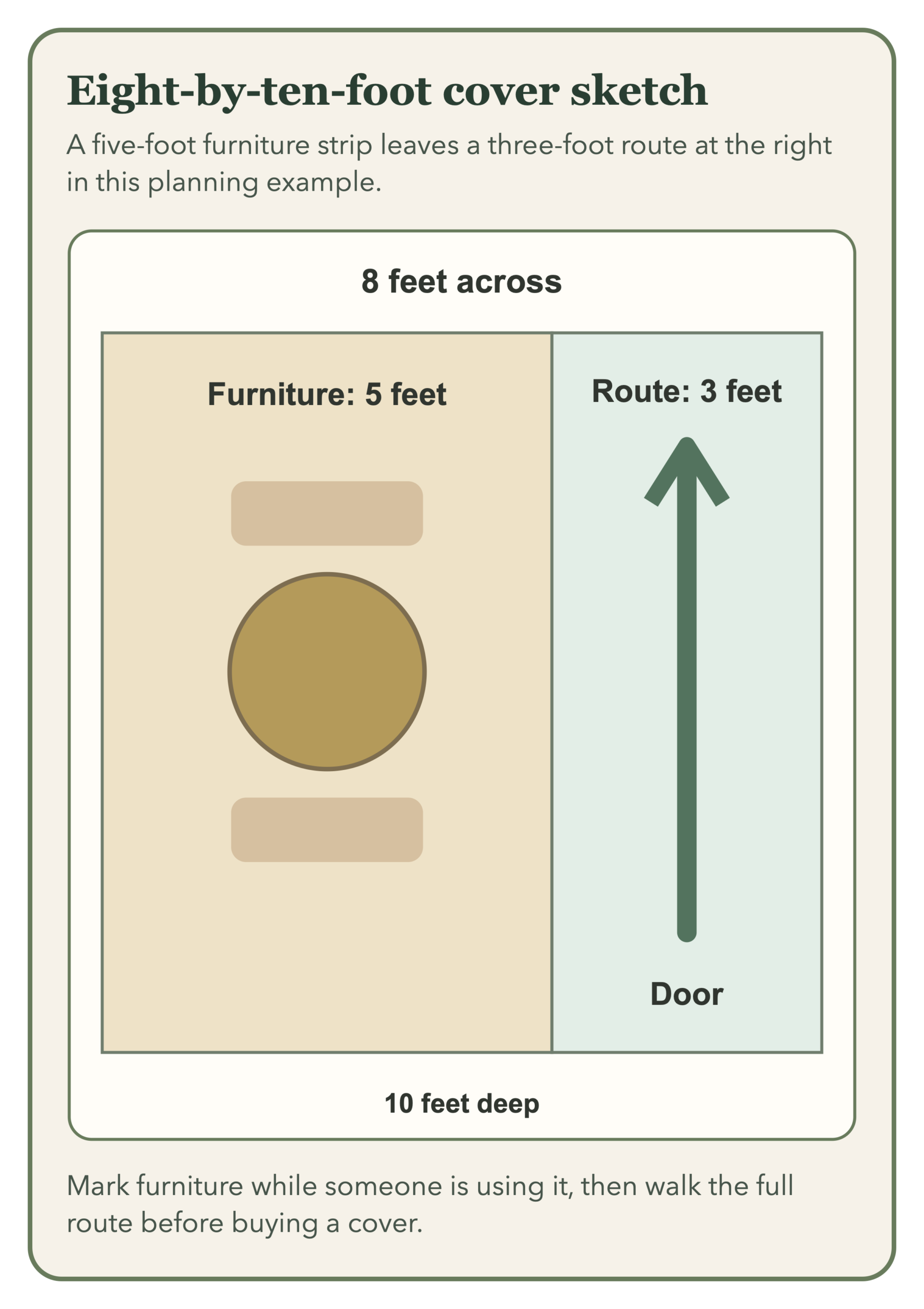
If dinner is the point, plan a compact patio dining layout with the chairs pulled out and about 36 inches behind each one. A generous tabletop is no help if someone has to tuck in a chair every time the door opens.
Check post and base conflicts before styling
Set a cardboard box where the umbrella base or a post would stand and live with it for a day. If it catches a chair leg or a hip, change the cover before you buy pots and lights. If the slab is cracked, sloped or thin, assess a concrete patio before adding a cover that will sit or bolt on it.
Under the finished cover, a low-profile fan helps on still, humid evenings. Choose a damp-rated fan for a covered patio and a wet-rated one where rain can reach it, size it around 42 to 52 inches for a 10 by 10 foot space, and keep the blades at least 7 feet above the floor. For pots in the new shade, ferns, hostas, heuchera and impatiens handle 2 to 4 hours of sun well.
Use a renter-or-owner stop/go checklist
A cover that needs no building work can still need a yes from someone, or more anchoring than your patio can give. Sort that out first.
Reversible choices and written permission
Renters, go for things that stand on their own and pack away: umbrellas with weighted bases, pop-up canopies, freestanding curtain frames. Anything screwed into a wall, rail or the ground needs the landlord’s permission in writing. In an HOA, check the rules even for a freestanding pergola, since many require approval for anything taller than a fence.
Structural, setback, utility, and permit boundaries
Owners have more freedom, and this is where the serious checks live. Most US towns require a permit for an attached patio roof and many for larger pergolas, with rules on footings, wind and snow loads, and how close you can build to the property line. Call 811 before any post hole so buried lines get marked for free, and have a contractor or engineer handle anything that ties into the house or carries a roof. Follow each product’s own anchoring and weather limits rather than borrowing a method from a different cover.
FAQ
How can I cover a small patio?
Match the cover to the hour and the weather you want to fix. For sun, start with a 9 to 10 foot umbrella; for daily shade, a sail or canopy; for light rain, an awning or a roofed pergola; for full shelter, a permitted patio roof.
What is the best cover for a small patio?
The best cover shades your seat at the hour you use it without blocking the door or darkening the room. For most small patios that’s a tilting cantilever umbrella or a retractable awning, because both can get out of the way when you want light.
Can I add shade without building a permanent roof?
Yes. Umbrellas, shade sails, pop-up canopies and freestanding pergolas all add shade without a roof, and most cost under $1,000. Weight or anchor them as the maker directs and take fabric down in storms.
How do I keep a covered patio from feeling dark?
Shade only the area and hours that need it. Choose pale fabric, open rafters or a translucent roof, stop the cover a foot or two short of the window, and add warm outdoor lights at around 2700K for evenings.
What should I check before adding a patio cover?
Check where the sun falls at three times of day, the door swing, vents, downspouts and a 36-inch walkway. Then read the product’s anchoring and wind limits, and confirm landlord, HOA and permit rules before buying anything that attaches or needs footings.
Final thoughts
A good cover fixes one weather problem and doesn’t create a new one at the door or in the living room. Start with the smallest fix for the uncomfortable hour and give it a few weeks before building anything permanent.
This week, sketch your patio, mark the shade at 8 a.m., 1 p.m. and 5 p.m., and test a borrowed umbrella over the hot seat. For more on how umbrellas, sails and trees compare, plus wind and pooled-rain cautions, compare practical ways to add backyard shade.
Last update on 2026-10-01 / Affiliate links / Images from Amazon Product Advertising API