
Small townhouse backyard ideas work when one daily use gets the open middle and everything else bends around it. Keep a strip about 36 inches wide from the back door to the gate, check who owns the fence before you attach anything, then give the center to the dog, the dinner table or the plants, whichever you’d use most often. Trying to fit all three usually means none of them is easy.
Many townhouse yards are only about 15 to 20 feet wide, and a gate, a hose bib, the trash bins and a neighbor’s upstairs window all claim space before a table or planter arrives. The yard can look empty and still feel hard to use.
So start with those fixed things, choose one main job for the space, and let the furniture follow. In a yard this size, it’s better to make one thing easy than three things barely possible.
Recommended products for a small townhouse backyard


Recommended blogs
- Long narrow backyard ideas
- Muddy small backyard ideas
- Small backyard ideas without grass
- Small backyard makeover
- Small patio ideas
12 townhouse backyard looks with personality
Each look should feel lovely from the back door and still work when you step outside. Pick the one that suits your most common day, then borrow colors and plants from the others only if they leave that day easy.
1. Let the planters frame the view
Three big planters just beyond the door do more than a dozen small pots. Pots 18 to 24 inches across with broad green leaves and a few pale flowers frame a simple bench and make the first view from the kitchen feel finished.
It’s a good answer when the door looks straight at a plain fence. A 20-inch pot of wet soil can top 100 pounds, so set the pots on caster saucers if you’ll ever need to move them.
2. Ready for guests, gone by dinner
A folding table and two chairs turn an open patch into a spot for lemonade or an extra supper seat, then fold to about 4 inches thick against the house. Pale wood, sage and cream keep the stacked pieces from becoming the main view.
This suits people who need open space for play or a pet most days but have friends over now and then. Decide where the folded set and cushions live before buying, or the setup becomes a chore you skip.
3. Low seats and a longer view
Low lounge chairs with a seat height around 14 inches, a shallow round table and low herb pots let your eye run to the far fence instead of stopping at tall furniture. Warm gray paving and olive green keep it quiet.
Deep lounge chairs often need 30 to 34 inches of depth each, more than they seem to in the store. Anyone who prefers a firmer chair at a standard 17 to 18 inch seat height will find them hard to get out of.
4. Two little zones, one easy route
Give one side to a gravel corner with a chair and the other to charcoal containers of loose green foliage and blush flowers. A single line of stepping stones, set about 24 inches center to center, ties them together.
It’s for someone who wants a little sitting and a little growing. Both zones get smaller, and loose gravel is hard going for strollers, wheelchairs or anyone walking out in the dark.
5. A bench that hides the clutter
A slatted wood storage bench, typically 4 to 5 feet long, gives cushions, hand tools or outdoor toys one tidy home and seats two people. Creamy textiles and leafy pots on either side make it read as seating first.
Look for drainage holes or a raised floor so cushions don’t sit in damp air. The lid needs about as much space above it as the bench is deep, so keep it out from under a low window sill.
6. A soft glow around the edges
Keep the center dark and put small pools of warm light beside the planters and along the edge of the path. Warm white bulbs around 2700K against dark leaves feel calm, where a bright string canopy over the whole yard can feel like a stage.
Aim fixtures down, ideally 18 inches or less above the ground, so nothing shines into the neighbors’ windows a few feet away. Solar stakes need no cord at all; plug-in lights need an outdoor GFCI outlet and a cord kept off the walkway.
7. Seasonal pots greet you at home
Near the back door, group one evergreen in a pot, one flowering pot and one plant that trails over its rim. Moss green, cream, pale pink and natural clay make the welcome feel planned even if the rest of the yard stays simple.
It’s a good one for renters, since it all leaves with you. Seasonal flowers in pots need water every day or two in July heat, so keep them within one hose length of the tap.
8. Bench the edge, free the middle
Run one long bench, 6 to 8 feet, along a side fence and leave the center bare. Weathered wood, oatmeal cushions and slim planting soften the edge while the middle stays free for toys, a dog or just walking through.
It works when open floor matters more than face-to-face talk. Two freestanding 4-foot benches are easier to move than one long built-in, and they don’t need anything screwed into a fence you might share.
9. A bistro moment by the door
A round table 24 to 30 inches across beside the kitchen door makes coffee or a quick lunch outside feel easy. Deep green metal, white seat pads and terracotta herb pots give it a little cafe character.
Pull both chairs out and sit down before judging the fit. With people in it, a bistro set takes about 6 by 6 feet, and if that blocks the door swing or the way to the gate, slide it a few feet along the wall.
10. A cozy corner, path still clear
Tuck one generous chair, a small side table and two big pots into a shaded corner. A dusty blue cushion, clay, ferns and old wood make it feel collected, and the path slips past instead of ending there.
One chair and a table need only about 4 by 5 feet, which is why this is the best pick for a regular reader or tea drinker. It won’t seat friends, and the cushion still needs a dry home.
11. Dinner waiting at the garden’s end
Put the dining table at the far end and let a straight path lead to it from the kitchen. Add natural wood, cream cushions, olive foliage and a touch of muted rust, and the far fence becomes somewhere you walk to on purpose.
It suits a yard whose most private patch is away from the house. Every plate travels 20 feet or more, voices carry to the neighbors’ patios, and the table takes ground that might be the sunniest spot for growing.
12. Townhouse backyard plan, seen clearly
Before choosing furniture, draw the yard from above on graph paper at a scale like 1 square to 1 foot. Shade the open middle, the planting, the pots and a clear line from door to gate, then add the hose, meter, drain, storage and the corner a neighbor overlooks.
A drawing hides slope, wind and where the property line really is. Take it outside with tape and cardboard and lay it out at full size before buying.
Start with a back-door-to-boundary route
Before placing a chair or pot, walk the trip you make most often. Wheel a trash cart from the back door to the gate. A standard 96-gallon cart is about 29 inches wide and 35 inches deep, so a 36-inch clear path is the realistic minimum, and you’ll want 48 inches at any turn.
University of Maryland Extension suggests listing existing features, foot and utility access, sun, shade, wind, slope and soggy spots before planning a landscape. That list shows what’s already there. It won’t tell you where the property line runs.
Map the door, gate, shared access, utilities, drainage, bins, and neighbor-facing edges
Open the back door all the way and leave about 3 feet clear beyond its swing. Walk to the gate with a bin and notice where you stop for the hose or to reach a meter or cleanout. Those trips should still feel ordinary once the yard is furnished.
On your sketch, mark the door swing, any shared walkway, utilities, bins and the direction rain runs after a storm. Look up too: an upstairs window next door may matter more to privacy than the fence.
If a long, thin yard is the real constraint, compare long narrow backyard layouts. If a patch stays wet for more than a day after rain, diagnose a muddy small backyard before adding a surface. Neither problem goes away by putting furniture on top of it.
Confirm ownership and permission before attaching or building anything
This is the one check that matters before anything gets screwed, dug or built. In townhouse communities, fences are often shared or owned by the HOA, and the line where your patio ends may not be your lot line. Read the plat or survey, your deed and the HOA rules (or your lease), and ask for written approval where it’s needed.
Many HOAs need approval for screens, sheds, pergolas and even paint colors, and the review can take 30 days or more. Call 811 a few days before digging so buried lines are marked. Until you have answers, stick to freestanding pieces that you can carry away.
Choose the yard’s primary daily use
For one week, notice what makes you open the back door. It might be letting the dog out three times a day, eating dinner outside on weeknights, or watering tomatoes before work. Let that repeat use claim the best open space. A table for an imagined party shouldn’t take the ground a dog uses every morning.
Rank pets, dining, and gardening by frequency, storage, and maintenance
Write down how often each use happens, at what time of day and season, and who has to be there. Add the less glamorous parts: muddy paws, where chairs and cushions go, watering, soil bags, cleaning, supervision.
If two uses tie, pick the one that is hardest to set up from scratch each day. A dog needs the space every day; a table can come out of storage on Friday.
Build one compact base plan
Picture a yard about 16 feet wide and 20 feet deep. You step out of a back door near the right corner, and the gate is straight ahead at the far right, with the hose bib and a utility meter beside it. Rain runs toward a drain along that same right side, and neighbors look in from both sides.
Those things stay put whatever you do with the middle. The plan only helps if your own measurements and lot lines leave room for it, so swap in your own numbers.
Preserve the way through, one flexible open area, storage, privacy, and a planting edge
I’d keep the right-hand 3 to 4 feet clear from door to gate. That leaves an easy line for bins and watering cans, even when the middle is in use, and it keeps the drain and meter reachable. What’s left is a single open area of roughly 10 by 12 feet, more useful than several cramped corners.
On the left, one storage bench covers seating and storage in a single spot. A slim planting strip 18 to 24 inches deep and a privacy screen can sit toward the back left, as long as neither crowds the drain. K-State Research and Extension describes a home landscape as a set of connected use areas. Here, the back door is what connects them.
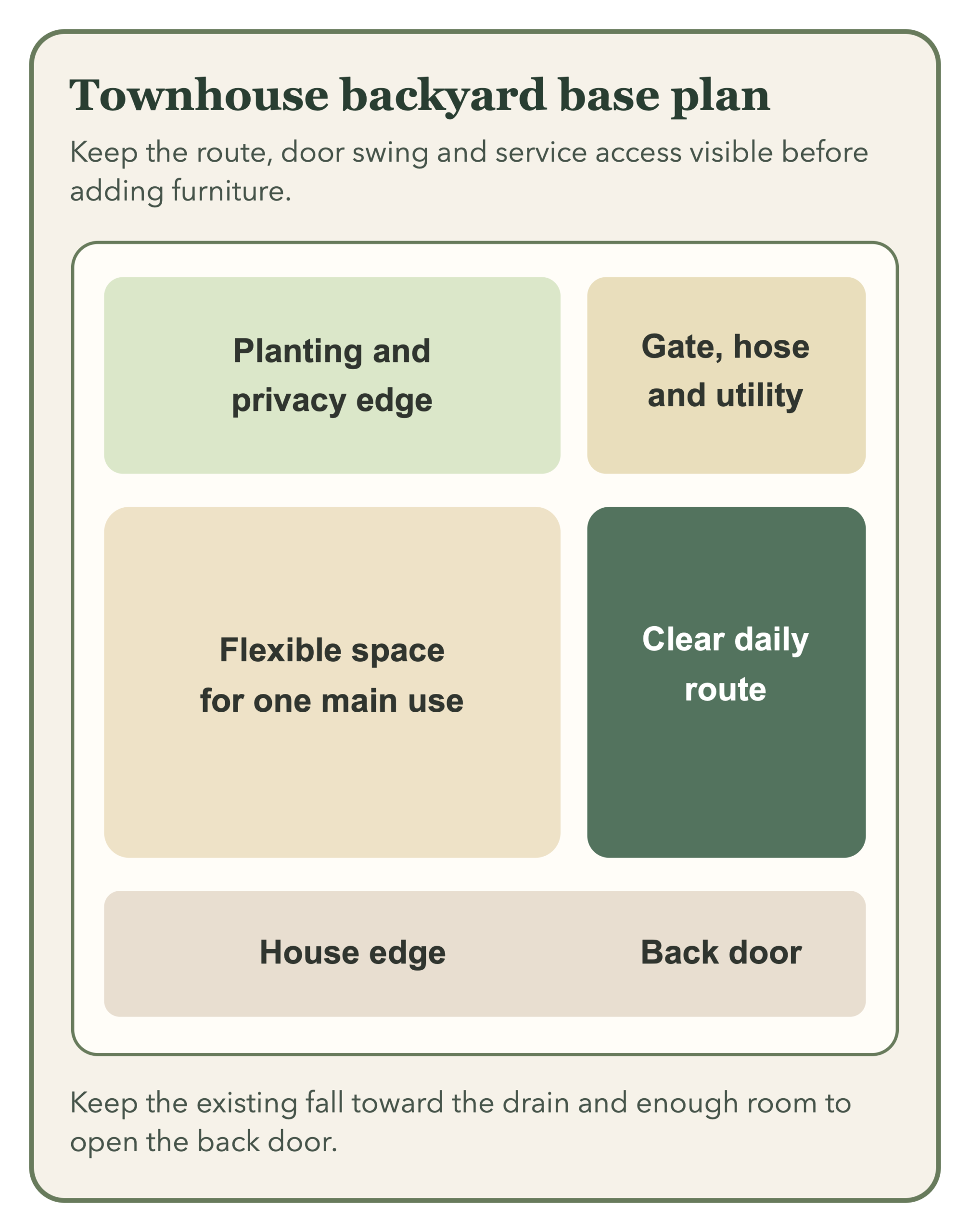
Switch the base plan for pets, dining, or gardening
That 10 by 12 foot middle can’t be a dog run, a dinner spot and a vegetable patch at once. Give it to the use you return to most often. The others can still visit, but they’ll need to be smaller or easy to move.
Pet priority: protect supervision, movement, shade, and plant safety
If a dog goes out every day, keep the middle open and put one low seat on the left where you can watch without standing in the way. Make sure there’s shade at midday and a water bowl that stays filled.
Check the gate latch and look for gaps under the gate and fence; small dogs can squeeze through surprisingly narrow spaces, and a strip of hardware cloth or a gravel board closes most of them. Feel paving with the back of your hand on a hot afternoon: if you can’t hold it there for 7 seconds, it’s too hot for paws.
Look up every plant within reach in the ASPCA Toxic and Non-Toxic Plants database, and remember that a plant missing from the list isn’t automatically safe. Common yard plants such as sago palm, azalea, oleander and lily of the valley are toxic to dogs and cats.
The cost: no permanent dining set and very little planting. If worn grass is turning to mud, find out why first, and when a lawn no longer suits a dog, compare small-backyard surfaces that work without grass.
Dining priority: test seating with people in it and the kitchen-to-table trip
Set a two-person table in the middle and pull the chairs out as they would be at dinner. You need about 24 to 36 inches behind each chair to sit down and stand up, so a 30-inch table for two takes roughly 7 by 7 feet in use. A 36 by 60 inch table for four needs closer to 10 by 11 feet.
Carry plates out from the kitchen and see whether someone else can still reach the gate and hose. A folding bistro set earns its place only if it works with people in it and has somewhere to go when folded.
For evening meals, two or three warm downlights or a lantern on the table are usually enough. A 6-foot screen or tall planting at the back left softens the view from next door for whoever sits facing it.
The table takes most of the dog’s open space and pushes pots to the edges. That’s a fair trade if you eat outside 3 or 4 times a week from May to September, and a poor one for a table used twice a summer.
Gardening priority: match sun, water, drainage, reach, and tool storage
If growing is what draws you outside, give the middle and left edge to containers or a narrow raised bed. Tomatoes, peppers and most herbs need 6 to 8 hours of direct sun, so put them where the light actually falls, then fill shadier spots with leafy greens, which manage with 4 or so.
Keep raised beds no more than 24 inches deep from front to back if you can only reach from one side, or 48 inches if you can reach from both. Leave a working strip of about 18 to 24 inches to kneel beside them, and make sure overflow water heads toward the drain, not the neighbor’s patio.
Tools and soil bags need a home away from the door. Renters usually do better with movable containers than a built bed.
More planting means no room for a dinner table with chairs pulled out and a shorter run for a dog. If the yard gets under 4 hours of sun, switch to shade plants or choose a different priority.
Compare what each priority forces the other two to give up
The edges never change between versions: the door and gate stay put, the hose and meter stay reachable, and rain still runs to the drain. Only the middle changes hands.
| Priority | What it takes and gives up |
|---|---|
| Pets first | The open middle for play and toilet trips, one watching seat on the left, pet supplies stored safely. Gives up a permanent dining set and most planting. Drop it if gaps under the gate or blind spots can’t be fixed. |
| Dining first | A table with chairs pulled out (about 7 by 7 feet for two), a place for folded chairs and cushions, a screen facing the most exposed seat. Gives up the dog’s run and a broad garden bed. Drop it if seated chairs block the gate. |
| Gardening first | Containers or a narrow bed in the middle and left edge, room to kneel, tools stored off the path. Gives up the dinner table and most of the open run. Drop it if the yard gets under 4 hours of sun or watering would cross a shared walkway. |
Make storage and seating share the same spot
If I could buy only one piece for a small yard, it would probably be a storage bench. The catch: you have to be able to open it without moving anything else. Mark it on the ground at full size, then mark the lid open and a person standing in front.
A deck box bench of 70 to 120 gallons usually holds cushions for 2 to 4 chairs and runs about $80 to $250. If opening it means stepping into the way to the gate, move it before you buy.
Compare a storage bench, narrow cabinet, and indoor storage
A bench does two jobs on the left edge but takes 4 to 5 feet of fence. A narrow resin cabinet, often 24 to 32 inches wide and 18 to 24 inches deep, takes less wall but needs room for its doors to swing, and tall ones should be strapped to the wall or fence to stop them tipping.
“Weatherproof” on a listing usually means it sheds rain, not that it stays dry inside through a wet week, so read the maker’s details. Storing things indoors frees the most yard space but adds a trip every time you set up. Whatever you pick, keep the tap and meter clear.
Test the lid swing without blocking the way through
Beside a shared fence, a cushion bench can look tidy until its lid swings up into the gate passage. Chalk the lid arc or cabinet door swing on the ground and try opening it with the rest of the furniture in place.
Then carry a cushion back inside. If that everyday task closes the passage, a smaller piece or indoor storage serves you better.
Add privacy without closing in the yard
Screen the seat, not the whole fence. Sit where you’ll actually sit, find the one window or gap that bothers you, and block just that line of sight. A single 6-foot panel placed 3 or 4 feet from the chair hides more than a taller one at the property line.
Check permission, wind, light, drainage, neighbor impact, and maintenance access
Many US towns cap backyard fences and screens at about 6 feet, and HOAs often set their own rules, so check both. A freestanding screen catches wind like a sail; weight the base with sandbags or pavers, or choose one with stakes, and keep its feet off the drain and the walkway.
Plants soften a view more gently. A row of tall grasses or columnar shrubs in 18 to 24 inch pots gives partial screening without permanent changes, though it still needs water and about 2 feet of depth. Neither option gives total privacy. If both would crowd the yard, move the chair instead.
Run the shared-edge and full-size check
Mark your chosen version at full size with tape, cardboard and the furniture you already own. Do it at the hour you’ll use the yard, so the sun, shade and neighbors’ windows are real.
Test the door, movement, furniture in use, storage, and mature plants together
Open the door and wheel a bin to the gate. Ask someone to sit at the table, or follow the path the dog would take. Then open the storage, reach the hose, and check you can get along the shared fence to clean it and to tend plants once they’re full size.
If anything pinches, shift it a foot and try again. Some tradeoffs will remain, like a low screen that keeps the light but leaves the table partly visible. Decide if you can live with that before you buy.
FAQ
How do I make a small townhouse backyard feel useful?
Keep a 36-inch path from the back door to the gate and give the open middle to the thing you do most often. One easy daily use beats three cramped ones. Fill the edges with storage seating and pots.
What should I check before adding privacy to a townhouse backyard?
Check who owns the fence, your HOA rules or lease, and local height limits, which are often around 6 feet. Then make sure a screen can be weighted against wind and won’t block the drain, light or the way to the gate.
Can a small townhouse backyard work for pets and dining?
Yes, if the dining is occasional. Keep the middle open for the pet and use a folding bistro set that comes out for meals and folds flat after. A permanent table for four usually leaves too little room for a dog in a yard under about 300 square feet.
What furniture works best in a compact townhouse backyard?
Folding bistro sets, storage benches and one comfortable chair work best. Test each with people sitting in it: a 30-inch table for two needs about 7 by 7 feet once the chairs are pulled out. Skip anything that blocks the door swing or gate when in use.
How do I add storage without crowding a townhouse backyard?
Use one storage bench that doubles as seating, or a narrow cabinet 24 to 32 inches wide against the house. Mark the lid or door swing on the ground first. If it blocks the path when open, store the items indoors instead.
Final thoughts
Tonight, chalk or tape a 36-inch path from the back door to the gate and decide which single use gets the middle. Then plan functional outdoor use areas with K-State Research and Extension’s guide in hand, and buy only the pieces that pass a full-size test in your own yard.
Last update on 2026-10-01 / Affiliate links / Images from Amazon Product Advertising API